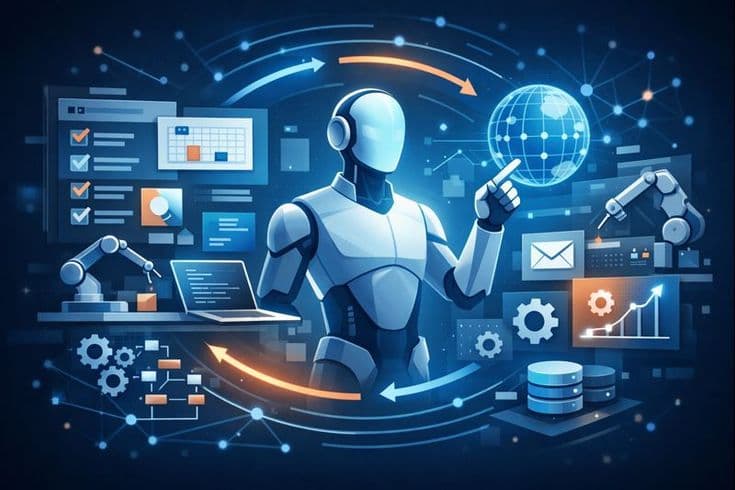
Generative AI has surged into 2026 as autonomous agents, evolving from text generators to proactive systems that plan, decide, and execute tasks independently. These "agentic" AIs break down complex goals into steps, like orchestrating travel itineraries or debugging codebases without prompts.
Multimodal Mastery Unleashed
Gone are single-mode limits; top models like Google's Gemini 3 and OpenAI's GPT-5.2 handle text, images, video, and audio seamlessly. Generate a video report from a text brief, or simulate drug trials with synthetic data—privacy-safe and hyper-realistic. Efficiency leaps via model compression slash compute needs, enabling edge deployment on phones.
In enterprises, agents automate 40% of workflows: finance risk models, healthcare diagnostics, manufacturing predictions. Gaming thrives with emergent stories where NPCs converse naturally, cutting dev costs while boosting immersion.
Enterprise and Creative Explosion
Hyper-personalization dominates marketing—tailored ads from viewer data in hours. Video production drops from weeks to minutes, fueling ads and training sims. Domain-specific models excel: healthcare for patient education, finance for fraud detection.
Synthetic data floods R&D, mimicking real datasets without breaches, accelerating autonomous vehicles and pharma. Chained prompts link models, where one output feeds another's input for compounded intelligence.
Hurdles and Ethical Guardrails
Deepfakes spur authenticity checks; regulations like EU AI Act tier risks. Hallucinations fade with retrieval-augmented generation tying outputs to facts. Energy hogs optimize via "mixture-of-experts," halving power use.
Businesses reskill for AI collaboration, unlocking revenue while debating job shifts. By mid-2026, expect "agent societies" negotiating peer-to-peer, redefining human-AI symbiosis.
Generative AI isn't creating content—it's crafting futures, from personalized worlds to solved crises.